
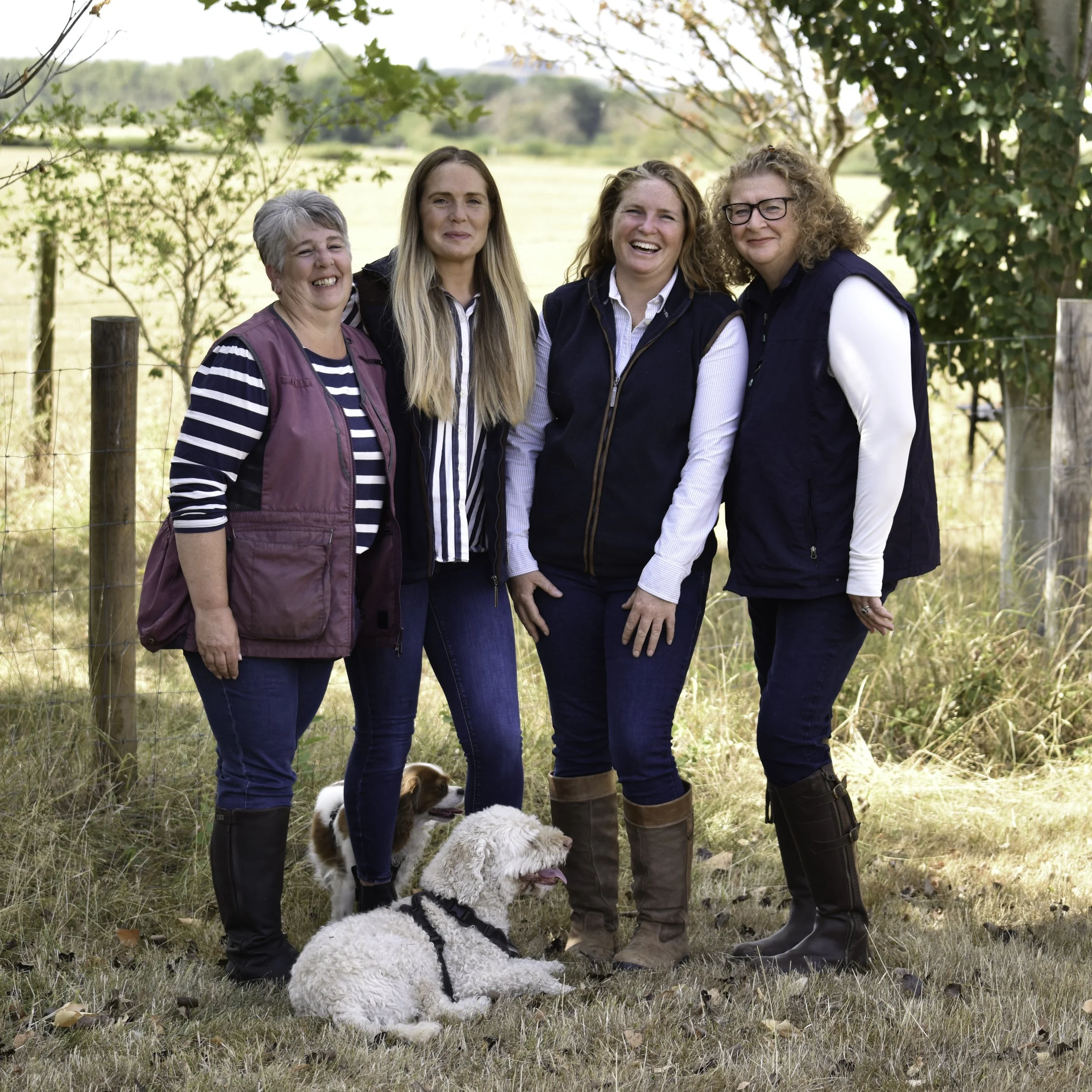
Our Team.
We’re a passionate team of behaviourists, trainers and dog lovers, dedicated to helping dogs and their people build happy, confident and rewarding partnerships.
With a wealth of experience and a range of specialist interests, we take a practical, compassionate and individual approach to every dog and owner we work with. From puppy training and everyday life skills to more complex behavioural challenges, we’re here to support you every step of the way.
Meet the team behind the practice and discover the people who are passionate about helping you and your dog thrive.
Jennie Shaw

Jennie is a COAPE-qualified behaviourist with many years’ experience supporting dogs and their owners. She leads the behaviour team, helping clients achieve practical, lasting results.
Passionate about training, Jennie also runs structured, welcoming classes for all levels. Her particular interests include behavioural challenges, rehomed dogs, adolescents, life skills and pet gundogs, with a focus on helping owners turn training and behaviour progress into real-world success.
Jennie lives with her husband and their two dogs: Edie, a Potcake from St Lucia, and Bilbo Baggins, a very sweet rehomed Lagotto.

Charley Ambrose
Charley is a qualified COAPE Behaviourist and Trainer, as well as a specialist Concept Games Trainer, with years of experience building strong, positive partnerships between dogs and their owners.
She has a particular passion for puppy training and helping owners build the right foundations to prevent behavioural challenges later in life. Charley makes training relevant, practical and results-driven, drawing on her extensive knowledge as a Concept Games Trainer to help dogs and their owners succeed in everyday life.
Charley lives with her husband, two young children and their three beautiful dogs: Bella and Georgie, two Spanish Water Dogs, and Lottie, the newest addition to the family, a Working Cocker Spaniel.

Carolanne Street
Carolanne Street is a passionate dog advocate who is dedicated to supporting dogs and their people. She works in the practice alongside Jennie as a class assistant and also supports behaviour clients on a 1:1 basis as part of their individual behaviour modification plans.
Carolanne has a particular interest in consent-based handling, scentwork, trick training and canine conditioning, and loves helping dogs build confidence, skills and positive associations through training.
Outside of the practice, Carolanne shares her life with her husband and her beautiful Nova Scotia Duck Tolling Retriever, Ruby. Ruby keeps her busy with plenty of adventures, training and, of course, lots of fun!

Libby Ambrose
Libby heads up customer service and client management and will often be your first point of contact. With many years’ experience as a senior veterinary nurse, she is passionate about supporting both dogs and their owners.
Within the practice, Libby also works as Charley’s training assistant and particularly enjoys working with puppies through 1:1 training sessions.
Outside of work, Libby lives with her sassy and opinionated Cavalier King Charles Spaniel, Betty, who certainly keeps her on her toes!
Find Us.
We are now based at Paws at Manor Farm, Drayton St Leonard. When you receive confirmations of classes or one to ones we will send with you full instructions about how to get to us.
Our Ethics, Qualifications & Professional Standards
At The Canine Behaviour Practice, we believe that anyone working with your dog’s behaviour should be appropriately educated, professionally accountable and committed to protecting your dog’s physical and emotional welfare.
Dog training and behaviour remains an unregulated industry in the UK. This means that the terms dog trainer and behaviourist are not, in themselves, a guarantee of qualifications, professional standards or ethical methods.
For us, that makes professional education, recognised qualifications, continuing development and accountability particularly important.
A Professionally Qualified Team
Our team has invested significantly in recognised education in canine behaviour and training.
Jennie Shaw and Charley Ambrose are both COAPE-qualified canine behaviourists and trainers.
Carolanne Street also holds a COAPE dog training qualification, and Libby Ambrose is currently completing her COAPE dog training qualification.
Our qualifications are not simply badges to display. They underpin the way we assess dogs, understand behaviour, construct training plans and make decisions about the welfare of the dogs in our care.
Jennie and Charley are members of CABTi – the COAPE Association of Behaviourists and Trainers International.
The UK Dog Behaviour & Training Charter describes CABTi as:
“A members association for COAPE-qualified behaviourists, and a founding member organisation of The Charter.”
CABTi is also listed by the Charter as an approved qualifying organisation for behaviourists.
This means that our professional membership sits within a wider framework of recognised qualifications, ethical standards, continuing professional development and professional accountability.
The UK Dog Behaviour & Training Charter
We strongly support and work in accordance with the principles promoted by the UK Dog Behaviour & Training Charter.
The Charter was established to raise standards within the UK dog training and behaviour industry.
Its member organisations commit to shared professional standards on behalf of their accredited members, including:
force-free, positive reinforcement-based methodology
prohibition of aversive training tools
monitoring of accredited members’ ongoing compliance
professional accountability
appropriate complaints and grievance procedures
continuing professional standards and development.
The Charter operates through professional member organisations rather than individuals joining it directly. Accredited professionals belonging to an approved Charter Member Organisation work under the standards and oversight of their own professional organisation and the wider Charter framework.
For our clients, this matters.
It means that our approach is not based simply on personal opinion, social-media trends or whatever happens to produce the quickest visible change in a dog’s behaviour.
There are professional, educational and ethical standards behind the way we work.
Our Commitment to Your Dog
The welfare of the dog is at the centre of everything we do.
When you work with us, you can expect us to:
Put your dog’s physical, emotional and behavioural welfare first.
Use reward-based, force-free and non-punitive approaches to training and behaviour change.
Look at why a behaviour is happening, rather than simply trying to stop or suppress what the dog is doing.
Consider the whole dog, including health, pain, emotional state, previous learning, environment, relationships and life experiences.
Work at a pace the individual dog is able to cope with.
Adapt our approach to the dog in front of us rather than applying one method to every dog.
Explain what we are doing and why.
Work within the limits of our individual professional competence.
Refer to or work collaboratively with veterinary surgeons and other appropriately qualified professionals when this is in the dog’s best interests.
Maintain and develop our knowledge through ongoing education and Continuing Professional Development (CPD).
Treat dogs, their families and fellow professionals with compassion, honesty and respect.
What We Will Not Do
We do not believe that fear, pain or intimidation are necessary to train a dog or change behaviour.
We will not use or recommend training methods designed to deliberately cause pain, fear, alarm or intimidation.
This includes the use of equipment such as:
electric shock or e-collars
prong collars
choke or check chains
anti-bark collars
citronella or other aversive spray collars.
The Charter’s published core standards require member organisations to use force-free, positive reinforcement-based methodology and prohibit aversive tools including prong collars, choke chains and e-collars.
We also do not believe in deliberately placing a dog into a situation they cannot cope with simply to force a response or produce a rapid change in behaviour.
A behaviour disappearing is not enough for us.
How the dog feels while that behaviour is changing matters.
Behaviour Is Communication
Behaviour gives us information.
A dog who barks, lunges, freezes, growls, hides, runs away, struggles to settle or finds everyday situations difficult is communicating something about how they are experiencing that situation.
Our role is not simply to silence that communication.
We want to understand what is driving it.
That may mean considering fear, frustration, arousal, previous learning, physical health, pain, environment, unmet needs or a combination of factors.
Once we understand the picture more clearly, we can begin to make meaningful changes for both the dog and the people living with them.
There Are No Ethical Quick Fixes
Some methods can produce a very rapid change in what we can see.
That does not necessarily mean the underlying problem has been resolved.
When we are working with fear, anxiety, reactivity or more complex behavioural difficulties, meaningful and sustainable change can take time.
We will never knowingly compromise a dog’s welfare in pursuit of a quick result.
Our aim is not simply to create a dog who looks compliant.
Our aim is to help dogs become safer, more confident, better understood and better able to cope with their lives.
Professional Accountability Matters
We believe every dog owner has the right to know who is advising them about their dog.
Before choosing a trainer or behaviourist, it is reasonable to ask:
What qualifications do you hold?
Who are you professionally accountable to?
What methods will you use with my dog?
What methods and equipment will you not use?
How do you keep your knowledge up to date?
What happens if I have a concern?
We think professionals working with dogs should be able to answer those questions clearly.
Through our COAPE qualifications, CABTi membership and commitment to the standards of the UK Dog Behaviour & Training Charter, we choose to work within a professional framework that places education, ethics, welfare and accountability at the centre of practice.
The Charter also publishes its Code of Conduct, complaints process and oversight arrangements, providing an additional level of transparency and accountability.
Our Promise
We cannot promise that changing behaviour will always be quick or easy.
We can promise that we will approach your dog thoughtfully.
We will listen.
We will look at the whole picture.
We will explain what we are doing and why.
We will continue to learn.
We will work within our professional competence and involve other professionals when your dog needs them.
And we will never knowingly compromise your dog’s welfare simply to achieve a training result.
Kindness and good science are not alternatives to effective training. They are fundamental to it.